The verdict
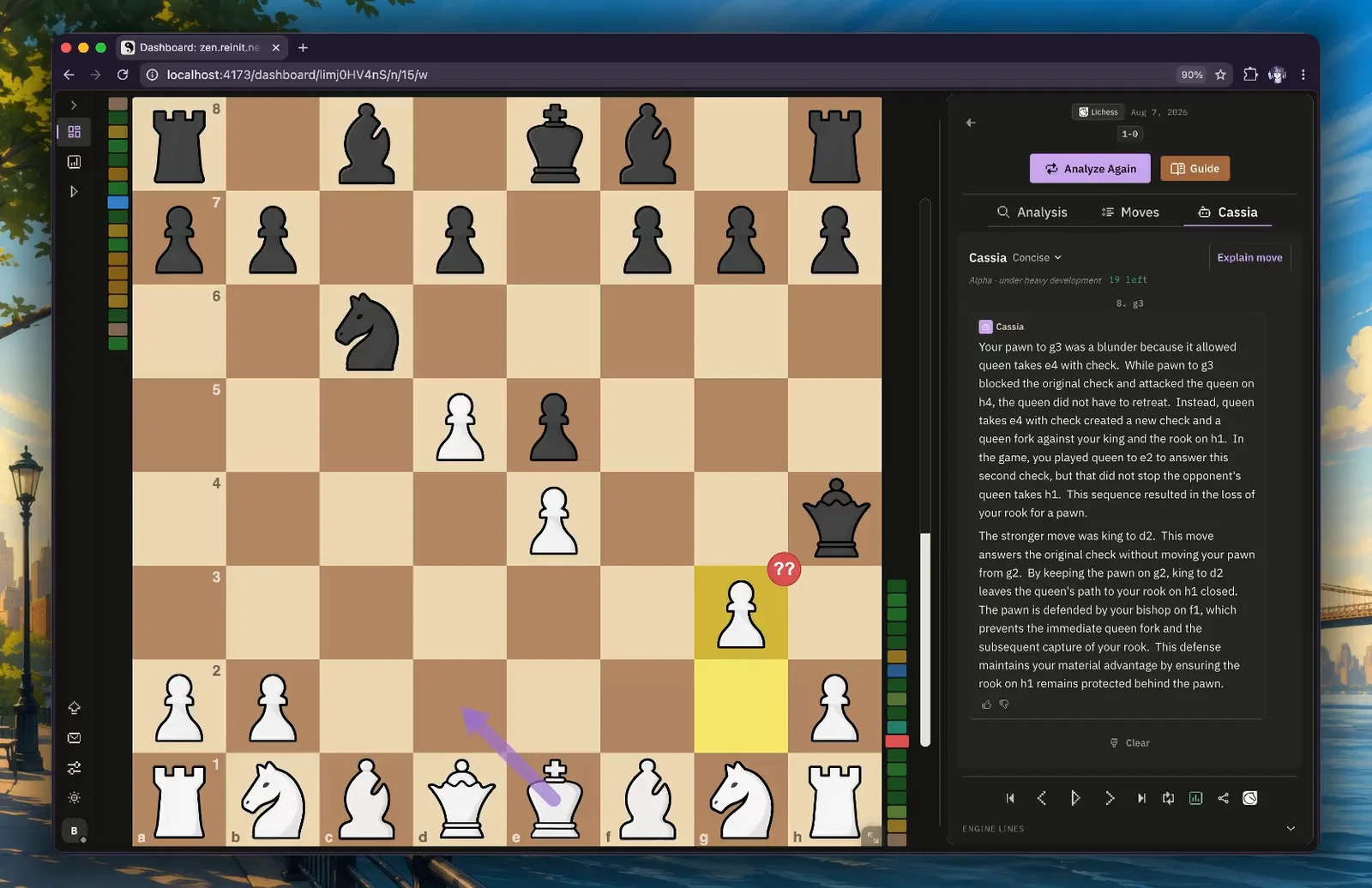
8. g3? is classified as a blunder.
 Zen by reinit
AI chess analysis
Stockfish finds the evidence. Cassia connects it to the threat, tactic, structure, or plan behind the move.
General language models are not reliable chess engines. Zen gives calculation and explanation different jobs: Stockfish establishes what happened on the board, then Cassia helps translate those facts into chess reasoning.
Read how Cassia is groundedA grounded explanation
This recording comes from the working product. It shows the concrete reason behind the classification and the defensive idea in the stronger move.
8. g3? is classified as a blunder.
The move allows ...Qxe4+. The check gains time and creates a fork against the king and the rook on h1.
Kd2 answers the check while the pawn on g2 still blocks the queen's path to h1 and remains defended.
Play the suggested defence in Explore, then use Simulation to see whether the idea survives a realistic continuation.
The engine evaluates the position, compares candidate moves, and supplies the concrete lines behind the verdict.
Cassia turns the engine evidence into a reason you can follow on the board, without pretending language is calculation.
Explore lets you play the alternative. Simulation adds resistance so the explanation becomes something you can test.
Zen is a personal chess review workspace, not a disposable report. Import Chess.com, Lichess, or PGN games, return to their turning points, and keep the analysis available in your library.
Exporting a .zen file can preserve classifications and Cassia conversations alongside the game, so a useful review does not have to begin again from raw PGN.
See the complete feature referenceZen separates chess calculation from language. Stockfish analyzes the position and candidate lines. Cassia uses that engine-grounded evidence to explain the threat, tactic, structure, or plan behind the result in plain language.
No. Stockfish is the chess engine. Cassia is the explanatory assistant inside Zen. It does not replace engine analysis or independently invent the evaluation.
Yes. After Zen analyzes a game, select a move and ask Cassia to explain it. Cassia can connect the evaluation change to concrete details such as a missed check, hanging piece, tactical sequence, weakened square, or plan.
Zen can import games from Chess.com and Lichess by username, or accept a pasted or uploaded PGN. The games can remain in a personal local library for later review.
No account is required for the local game library, browser-based Stockfish analysis, Explore, or Simulation. Cassia requires an account because it uses an optional AI-assisted service.
Yes. Cassia is in active development and can still produce an incomplete or incorrect explanation. Zen shows the board, engine lines, and analysis context so players can verify the explanation rather than treating it as an unquestionable verdict.
No account is required to start with the local library and Stockfish analysis.
Analyze a game